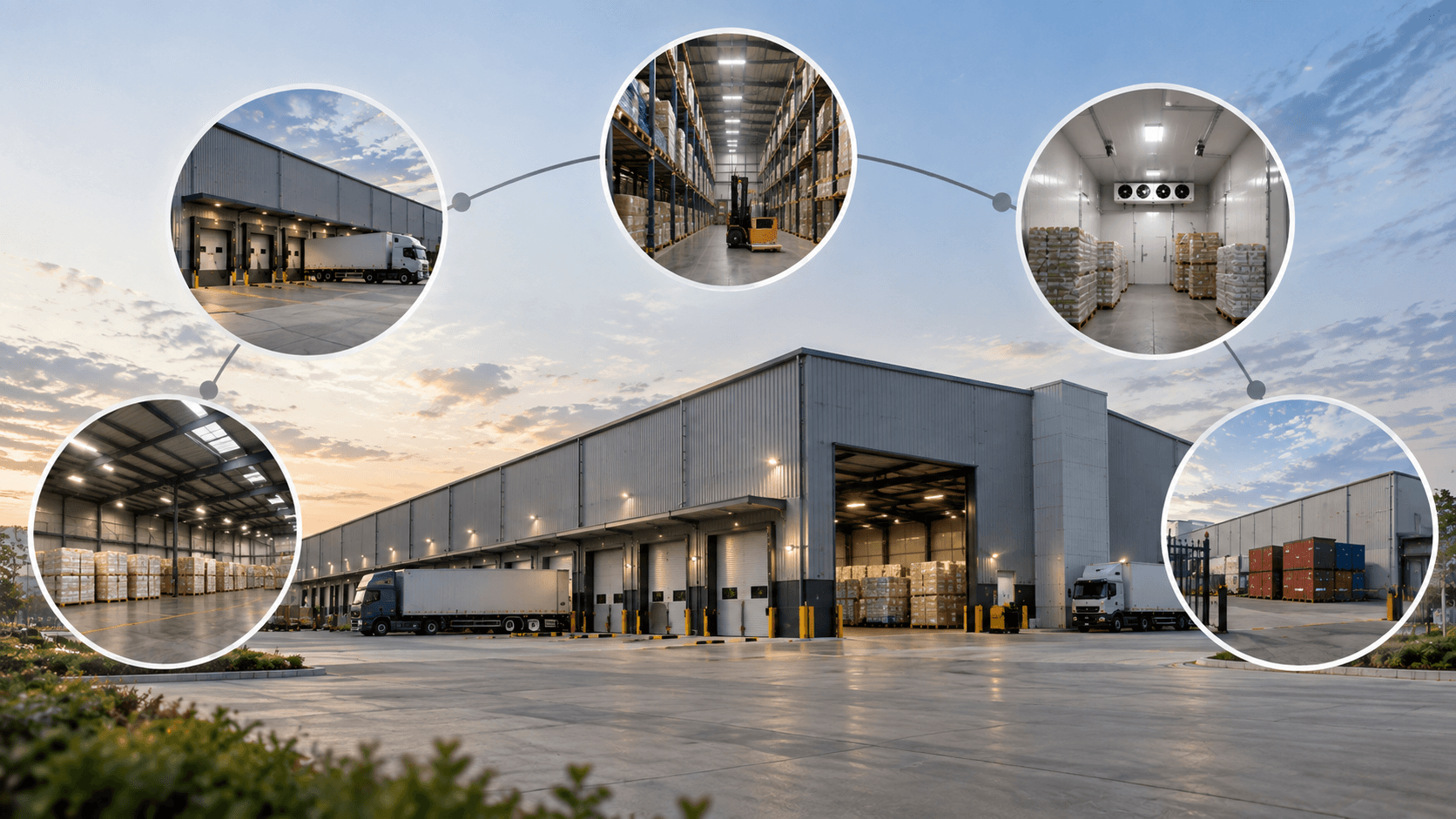
Types of Warehouse: How to Pick the Right One Before You Build
You know you need storage, but the harder question is what kind. Pick the wrong warehouse and you feel it every day. Racks that don't fit the space, a roof too low for high stacking, a layout that makes your forklifts crawl. The building shape drives your running cost for the next twenty years, so the choice matters more than most buyers think.
Let me walk you through the main types of warehouse and where each one earns its place.
Start with what you store
Before you look at any design, answer one question: what goes inside? Pallets or loose goods? Room temperature or cold? Fast-moving stock or long-term storage? Heavy machinery or light packaged items? The answer decides everything after it. The different types of warehouse exist because stock behaves differently, and a building that suits frozen food is wrong for steel coils. Get this clear first and the rest follows.
The main types of warehouse
Most builds fall into one of these groups. Here is what each type is for and what it needs from the structure.
General storage warehouse
The workhorse of the industry. Open floor, wide clear span past 30 metres, and tall eaves for vertical racking. It suits packaged goods, boxed stock, and palletised inventory. Most warehouses across the belts near Ludhiana or Baddi fall here. Simple, flexible, and cost-effective.
Cold storage warehouse
Built for food, pharma, dairy, and perishables that need temperature control. It needs insulated panels, sealed junctions, and a frame designed for panel weight and airtight cladding. Of all the types of warehouse, this one is least forgiving of shortcuts, because a weak seal costs you in power bills every hour.
Distribution warehouse
Built around movement, not long storage. Stock comes in, gets sorted, and goes out fast. It needs wide doors, plenty of loading bays, high clearance, and a layout that keeps goods flowing from inbound to outbound. Bay spacing and door placement matter most here.
High-bay and automated warehouse
For when land is costly and you build up, not out. Stock stacks much taller, often with automated retrieval. The structure needs tight tolerances because the racking may carry part of the load. It costs more per square foot but pays back in storage density.
Industrial and heavy-goods warehouse
For heavy stock like steel, machinery, and bulk raw material. It needs a stronger floor, heavier framing, and often an overhead crane. Eave height must clear the crane hook plus service space. Of all the types of warehouse, this one is engineered closest to a factory shed.
Match the structure to the code, not the guess
Whatever type you pick, the steel behind it has to be right. Every structure we build follows Indian standards. We design to IS 800:2007 for steel, IS 875 (Part 3) for wind, and IS 1893 for seismic loads. That matters across Punjab and Himachal, where wind speeds and seismic zones shift over short distances. A warehouse for a flat plot near Ludhiana is not the same as one on a hillside plot in HP. We run full structural analysis on every job before fabrication starts, so you pay for the steel the building needs and nothing more.
One team, from drawing to handover
Here is where most warehouse projects lose time. You hire a designer, then a fabricator, then a separate erection crew. When something doesn't line up on site, everyone blames someone else.
We do all three ourselves.
Synergy PEB started in 2021 under Synergy Group. Our facility in Nalagarh, Himachal Pradesh, spans over 70,000 square feet and produces more than 1,000 MT of steel every month. Design, fabrication, and erection sit under one roof. Change a layout halfway through and the drawing updates the same day. One team, one point of contact, one number to call. That control is why our sheds go up faster. Your civil team pours foundations while our shop cuts the frame, and when steel reaches site, it bolts together quick.
What to ask before you build
Not every supplier gets warehouses right, so ask a few sharp questions first. Ask who does the structural design and whether it's checked against current IS codes. Ask about clear span, eave height, and how the layout suits your racking. Ask about the coating system if you store anything corrosive. And ask for the erection timeline in writing. Straight answers tell you the supplier understands warehouses, not just steel selling.
Ready when you are
Your warehouse holds your stock, your cash, and your promise to customers, so choose its shape carefully. Planning any of the types of warehouse we covered, across Punjab, Himachal, or the north? Talk to us. We'll walk you through spans, heights, timelines, and cost in plain terms, before you spend a rupee.
Reach out to Synergy PEB and let's build storage that works for your stock.