Structural Steel Fabrication: What Separates a Good Job From a Costly One
A steel joint either fits on site or it doesn't. There's no halfway. When a beam arrives a few millimetres off, your crew stops, the crane waits, and your schedule slips while everyone figures out whose mistake it was. Complex structures punish sloppy work harder than simple sheds do. That is why structural steel fabrication is the part of the job you should never treat as a box to tick. Let me walk you through what actually decides whether it goes right.
Complex structures leave no room for guesswork
A plain shed forgives small errors. A complex structure does not. Think of a multi-storey frame, a heavy crane gantry, a tapering roof, or a mezzanine carrying live machine loads. Every member connects to the next, and every connection carries load in a specific direction. One member cut wrong throws off the pieces around it. Good structural steel fabrication starts long before cutting, in how carefully the shop reads and plans the drawings.
Where structural steel fabrication goes wrong
Most failures trace back to a handful of causes. Knowing them helps you spot a weak supplier.
Bad or rushed detailing
The shop drawings are the real blueprint. If the detailing skips a connection check or gets a bolt pattern wrong, the error travels all the way to your site. We treat detailing as engineering, not paperwork.
Wrong steel or wrong grade
Not all steel is equal. A member sized for one grade will underperform if a lower grade gets substituted quietly. We stick to specified grades and keep the paper trail to prove it.
Loose tolerances
Complex frames need tight tolerances because small gaps stack up across many joints. Structural steel fabrication done to loose tolerances looks fine in the shop and fails at assembly. We hold tight numbers so the pieces fit the first time.
Weak welding and inspection
A weld is only as good as its inspection. Skipped checks hide cracks that show up under load later. We inspect as we go, not after the truck has left.
Tolerances are the whole game
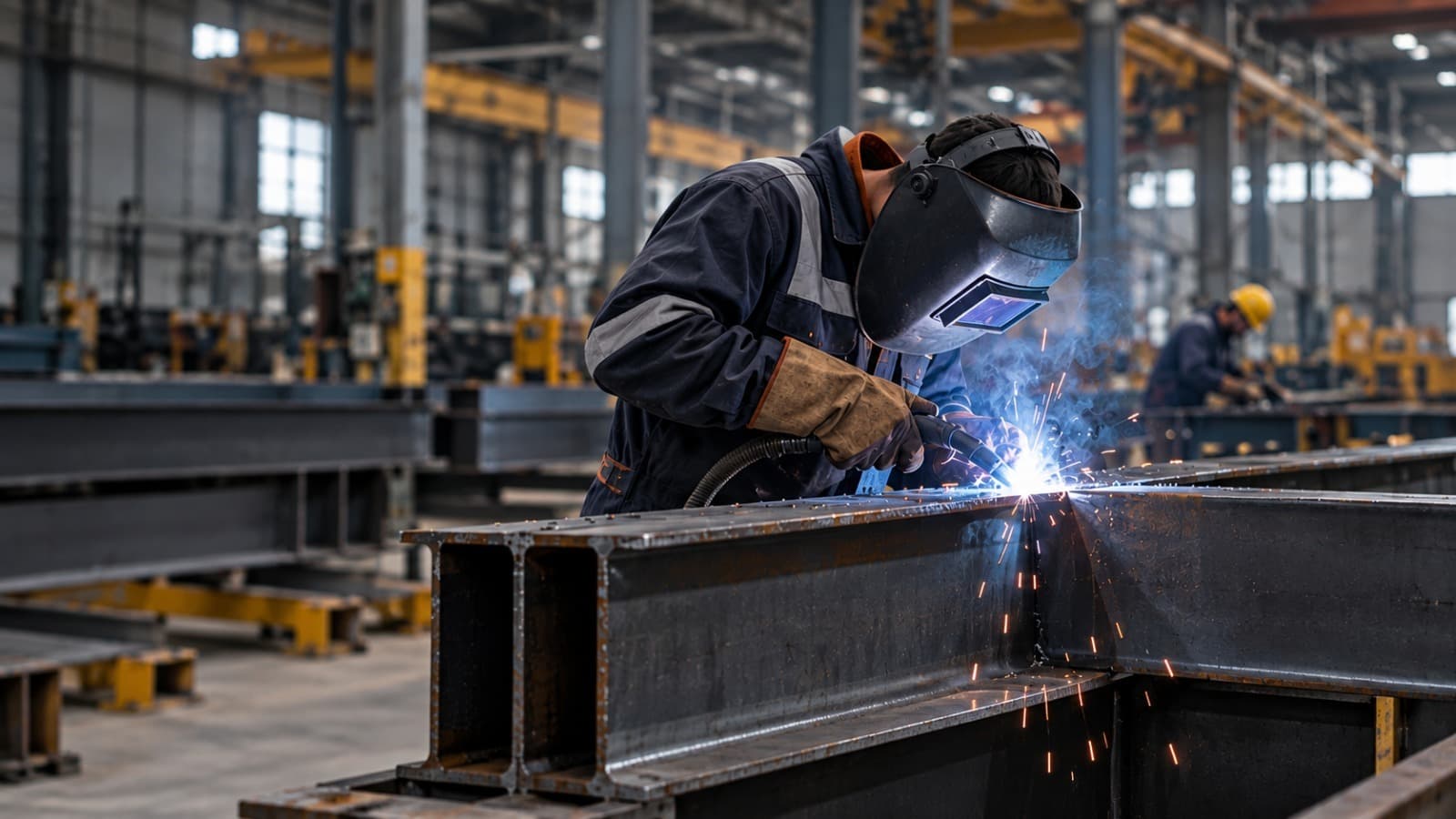
In simple work, a millimetre here or there rarely matters. In complex work, it always does. Imagine forty connections in a single frame. If each is off by two millimetres, the last piece is eighty millimetres out. It won't bolt up. Careful structural steel fabrication controls this at every stage, from cutting to drilling to welding. That discipline is why our complex frames go up without cutting, grinding, or forcing on site.
Built to code, checked before we cut
A complex structure that fails inspection is not a delay, it's a rebuild. Every job we do follows Indian standards. We design and fabricate to IS 800:2007 for steel, IS 875 (Part 3) for wind, and IS 1893 for seismic loads. That matters across Punjab and Himachal, where wind speeds and seismic zones change over short distances. A frame built for a flat plot near Ludhiana is not the same as one for a hillside site in HP. We run full structural analysis before fabrication starts, so the steel matches the load and nothing gets shaved thin to hit a price.
One team from drawing to erection
Here is where complex projects lose the most time. You hire a designer, then a fabricator, then a separate erection crew. When a joint doesn't line up on site, the fabricator blames the detailer and the erector blames the fabricator. You sit in the middle, losing days.
We do all three ourselves.
Synergy PEB started in 2021 under Synergy Group. Our facility in Nalagarh, Himachal Pradesh, spans over 70,000 square feet and turns out more than 1,000 MT of steel every month. Design, detailing, structural steel fabrication, and erection all sit under one roof. If a design changes, the shop knows the same day. One team, one point of accountability, one number to call. For complex work, that single line of control is worth more than a low quote.
What complex jobs we handle
Our shop is built for structures that give others trouble. Heavy crane gantries and mill buildings. Multi-storey steel frames. Long-span roofs and tapering geometries. Process plant structures carrying heavy equipment loads. Mezzanines rated for live machine loads. If it needs precise structural steel fabrication and tight erection, it fits our line.
What to check before you sign
Not every fabricator can handle complex work, so ask sharp questions first. Ask who does the detailing and whether they check every connection. Ask about steel grade and how they document it. Ask what tolerances they hold and how they inspect welds. And ask for the erection timeline in writing. Straight answers tell you the supplier understands structural steel fabrication, not just steel cutting.
Ready when you are
Your structure carries real load, real machines, and real risk if it's built wrong. It deserves a shop that treats fabrication as engineering. Planning a complex steel structure across Punjab, Himachal, or the north? Talk to us. We'll walk you through the design, tolerances, timeline, and cost in plain terms, before you spend a rupee.